

As a supplier of Food Grade Choline Chloride, I've witnessed a growing interest in the interaction of this vital nutrient with other dietary components. Choline chloride is an essential compound that plays a crucial role in various physiological processes, and understanding its interactions with other nutrients is of great significance for both consumers and the food industry.
The Basics of Food Grade Choline Chloride
Food Grade Choline Chloride is a water - soluble vitamin - like essential nutrient. It is widely used in the food industry due to its multiple health benefits. Choline is involved in neurotransmitter synthesis, cell membrane structure, and lipid metabolism. It is also necessary for normal brain development and function, making it an important addition to many food products, especially those targeted at infants, pregnant women, and the elderly.
Our Food Grade Choline Chloride meets the highest quality standards, ensuring its safety and efficacy for human consumption. It is carefully produced to maintain its purity and stability, so that it can be effectively absorbed and utilized by the body.
Interaction with Lipid - Soluble Vitamins
One of the key areas of interest is the interaction between choline chloride and lipid - soluble vitamins such as vitamins A, D, E, and K. Choline is known to play a role in lipid metabolism, and this may have implications for the absorption and utilization of these vitamins.
For example, choline is involved in the synthesis of phosphatidylcholine, a major component of cell membranes and lipoproteins. Lipoproteins are responsible for transporting lipid - soluble vitamins in the bloodstream. It is hypothesized that an adequate supply of choline may enhance the packaging and transport of these vitamins, thereby improving their bioavailability. Some studies have suggested that when choline intake is sufficient, the absorption of vitamin E may be increased. Vitamin E is a powerful antioxidant that protects cells from oxidative damage. By facilitating its absorption, choline chloride may contribute to overall antioxidant defense in the body.
However, more research is needed to fully understand the exact nature of these interactions. The balance between choline and lipid - soluble vitamins in the diet is complex, and factors such as the form of the vitamins, the presence of other dietary components, and individual physiological differences can all influence the outcome.
Interaction with B - Vitamins
Choline is often grouped with the B - vitamin complex because of its similar functions in the body. It interacts closely with other B - vitamins, including folate, vitamin B6, and vitamin B12. These vitamins are all involved in one - carbon metabolism, a biochemical pathway that is essential for DNA synthesis, methylation reactions, and homocysteine metabolism.
Folate and choline can both donate methyl groups in one - carbon metabolism. In some cases, they can substitute for each other to maintain normal metabolic function. For instance, when folate intake is low, choline can help to maintain proper methylation reactions. However, this substitution is not absolute, and an optimal intake of both nutrients is recommended for the best health outcomes.
Vitamin B6 and vitamin B12 also work in conjunction with choline in homocysteine metabolism. Homocysteine is an amino acid that, when present in high levels in the blood, is associated with an increased risk of cardiovascular disease. Choline, along with B6 and B12, helps to convert homocysteine into other non - harmful compounds. Therefore, a diet rich in these nutrients can contribute to maintaining healthy homocysteine levels.

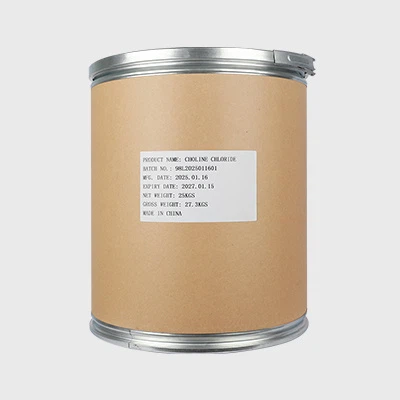
Our 98% Choline Chloride can be an important part of a balanced diet that includes an appropriate amount of B - vitamins. By providing a high - quality source of choline, it can support the normal functioning of one - carbon metabolism and overall health.
Interaction with Minerals
Choline chloride may also interact with various minerals in the body. For example, magnesium is involved in many enzymatic reactions, and choline may influence its availability and function. Some research has shown that choline can affect the absorption and distribution of magnesium in the body.
Calcium is another mineral that may interact with choline. Choline is involved in cell membrane integrity, and this may have an impact on calcium transport across cell membranes. In addition, the role of choline in lipid metabolism may indirectly affect calcium absorption, as lipids can influence the solubility and absorption of calcium in the gut.
These interactions are still being investigated, and more research is required to determine the practical implications for human health. However, it is clear that maintaining a proper balance between choline and minerals in the diet is important for overall physiological function.
Implications for the Food Industry
The understanding of these nutrient interactions has significant implications for the food industry. Food manufacturers can use this knowledge to develop fortified foods that optimize the delivery of multiple nutrients. For example, a food product that contains both choline chloride and lipid - soluble vitamins can be formulated in such a way that the interactions between these nutrients enhance their bioavailability.
Moreover, as consumers become more health - conscious, there is a growing demand for functional foods that provide multiple health benefits. By incorporating choline chloride and carefully considering its interactions with other nutrients, food companies can create products that meet these consumer needs.
Interaction with Other Dietary Components
Apart from vitamins and minerals, choline chloride may also interact with other dietary components such as dietary fiber and phytochemicals. Dietary fiber can affect the absorption of nutrients in the gut. It may bind to choline or other nutrients, altering their bioavailability. However, the specific nature of the interaction between choline and dietary fiber is not well - understood.
Phytochemicals, which are bioactive compounds found in plants, may also interact with choline. Some phytochemicals have antioxidant and anti - inflammatory properties, and they may work in synergy with choline to promote health. For example, certain flavonoids may enhance the antioxidant effects of choline - mediated lipid metabolism.
Importance for Different Populations
The interaction of choline chloride with other nutrients is particularly important for different populations. For pregnant women, choline is essential for fetal brain development. Ensuring an adequate supply of choline, along with other nutrients such as folate and iron, is crucial for a healthy pregnancy. The interactions between these nutrients can influence the proper growth and development of the fetus.
In the elderly population, choline may play a role in cognitive function. As people age, the risk of cognitive decline increases. Choline, in combination with other nutrients like vitamin B12 and omega - 3 fatty acids, may help to maintain brain health and reduce the risk of neurodegenerative diseases.
Conclusion
In conclusion, the interaction between food grade choline chloride and other nutrients is a complex and fascinating area of research. While there is a growing body of evidence suggesting potential interactions with vitamins, minerals, and other dietary components, much more work is needed to fully understand the mechanisms and implications.
As a supplier of Food Grade Choline Chloride, we are committed to providing high - quality products that can contribute to a balanced diet. Our products can be used in a variety of food applications, and we believe that by understanding these nutrient interactions, we can help food manufacturers create better - quality products for consumers.
If you are interested in learning more about our Food Grade Choline Chloride or discussing potential procurement for your food products, please feel free to reach out for further discussion. We are eager to collaborate with you to meet your specific needs.
References
- Blusztajn, J. K. (1998). Choline, an essential nutrient for public health. Nutrition Reviews, 56(7), 209 - 220.
- Zeisel, S. H., & da Costa, K. A. (2009). Choline: an essential nutrient for public health. Nutrition Reviews, 67(11), 615 - 623.
- Vance, D. E., & Vance, J. E. (Eds.). (2008). Biochemistry of Lipids, Lipoproteins and Membranes. Elsevier.
- Dawson, P. A., & Rudel, L. L. (2012). Absorption of lipid - soluble vitamins. The Journal of Nutrition, 142(5), 955S - 960S.